

What Is Nonprofit Marketing?

As a nonprofit organization, you have several audiences to juggle:
- Those you directly serve
- Those who support you financially
- Those who could support you financially
- Those who support you with their time, in-kind donations, etc.
- The larger communities in which you serve
- The influencers and advocates inside or outside your community whose voices can impact donor reach, brand exposure, and so much more
Nonprofit marketing works to engage all your audiences as effectively as possible through powerful, creative, and strategic messaging so that you can fulfill your organization’s mission. The goal is to optimize your reach so that you can ultimately grow your donor base, boost funding, and strengthen your impact in your community.
Nonprofit marketing involves knowing who you need to send your message to, crafting messages that will speak to each audience, selecting the channels that will best reach each audience, and tracking the metrics that show when and where a pivot in the strategy can further optimize your time, budget, and results.
The Challenges to Nonprofit Marketing
There are two main ways nonprofit organizations approach marketing:
- Start fresh from the beginning with every fundraising or brand-awareness campaign.
- Create and follow a strategic, well-crafted marketing plan that lays a strong foundation and game plan for every campaign included in the strategy.
Understandably, both approaches bring about challenges:
One-Off Campaigns Are Lower Cost, Low Reward
It’s too easy for organizations, particularly nonprofits, to think in the short term and focus on the marketing campaign right in front of them rather than craft a more effective, comprehensive, and long-term marketing strategy.
Why? Because the two resources that nonprofits need the most are time and money. Allotting either to marketing is difficult when so many other areas need the team’s time and the organization’s funds first.
It can appear frivolous to work marketing strategy creation into an already tight budget. Plus, it’s hard to incorporate market planning, campaign execution, and data tracking into an already packed schedule.
While one-off campaigns still have costs, leadership teams tend to see the benefit of saving on time and money with short-term marketing solutions, crafted and executed as needed or as able.
However, piecemeal marketing or marketing without a strategy ultimately hinders your efforts to extend your reach and grow your organization. At the end of the day, it still eats away whatever time and money was spent on the campaign and rarely brings about the return you were hoping to see.
Comprehensive Marketing Plans Bring Higher Rewards at a Higher Cost
Comprehensive marketing can achieve big results and still leave plenty of space in the budget for operations. Marketing plans can be created with budgets in mind, and budgets can be optimized to ensure you see big results from your efforts. However, moving the needle requires an intentional investment of time and money for thoughtfully planning strategies, executing campaigns, tracking metrics, and making adjustments that keep you on target to achieve your goals.
As mentioned, it can be hard for organizations to see the benefit of investing in a marketing plan when piecemeal marketing is possible.
Still, organizations that grow faster and stronger are the ones that maximize their marketing budgets with long-term strategies, effectively reaching and engaging with their audiences, especially donors and prospective donors.
What Does Nonprofit Marketing Entail?
The point of nonprofit marketing is to promote your organization’s mission, engage your supporters, and drive meaningful action. The core principles of marketing apply, but you must tailor your strategies to your unique values, audiences, and abilities. That typically includes:
1. Defining Clear Goals

Before launching any campaign, your nonprofit must establish specific, measurable goals that align with its broader mission. These may include:
- Increasing donor retention or acquisition
- Boosting event attendance
- Growing email subscribers or social media followers
- Raising awareness for an issue or cause
Clearly stated goals not only guide messaging and tactics but also help you assess the success of efforts and refine future strategies.
2. Establishing a Realistic Budget
Budgeting in the nonprofit world can feel like a balancing act. Even with limited resources, it’s essential to allocate funds toward marketing efforts that will make the biggest impact. These efforts can include digital advertising, print ads, billboard ads, and others. It’s vital to establish a realistic budget that is neither too small for what you need nor too big for what your organization can handle.
3. Crafting Core Messages
At the heart of every successful nonprofit marketing effort is a compelling message that lands nicely with audiences. Your core message should reflect the organization’s mission and values and speak directly to the emotions and motivations of your target audiences. The most effective core messaging is:
- Clear and concise
- Consistent across all platforms
- Adaptable to different audiences (donors, volunteers, beneficiaries, etc.)
- Centered around storytelling and impact
4. Selecting the Right Marketing Channels
Nonprofit marketing should span a wide range of channels to optimize audience reach. These may include:
- Email marketing that nurtures relationships and drives donations.
- Search engine marketing that enhances lead generation online.
- Social media marketing that optimizes community engagement and purpose awareness.
- Web design and blog creation to provide a central hub for information and content.
- Events and webinars that help build relationships and strengthen visibility.
- Print material creation, such as brochures, flyers, and direct mail campaigns, that tangibly put your message in front of audiences.
- Video and radio advertising that help reach broader audiences.
A multi-channel approach ensures a nonprofit can meet its audience wherever they are.
5. Tracking and Analyzing Data
Measuring results is crucial for refining strategies and understanding the impact of your efforts. Nonprofits should track both qualitative and quantitative metrics, such as:
- Email open and click-through rates
- Social media engagement and follower growth
- Website traffic and conversion rates
- Donation volume and average gift size
- Volunteer sign-ups or event registrations
- Campaign ROI and cost-per-acquisition
The Nonprofit Marketing Funnel: What Should It Look Like?
Every company or organization crafting a marketing plan should create a marketing funnel per goal and per audience. Designing the funnel for each goal in the strategy helps conceptualize what your tactics should include to optimize audience targeting, message creation, and goal success.
Each marketing funnel should include:
- The goal being pursued
- The audience to target
- The top, middle, and bottom phases of the audience/goal’s funnel
Marketing Funnel Example
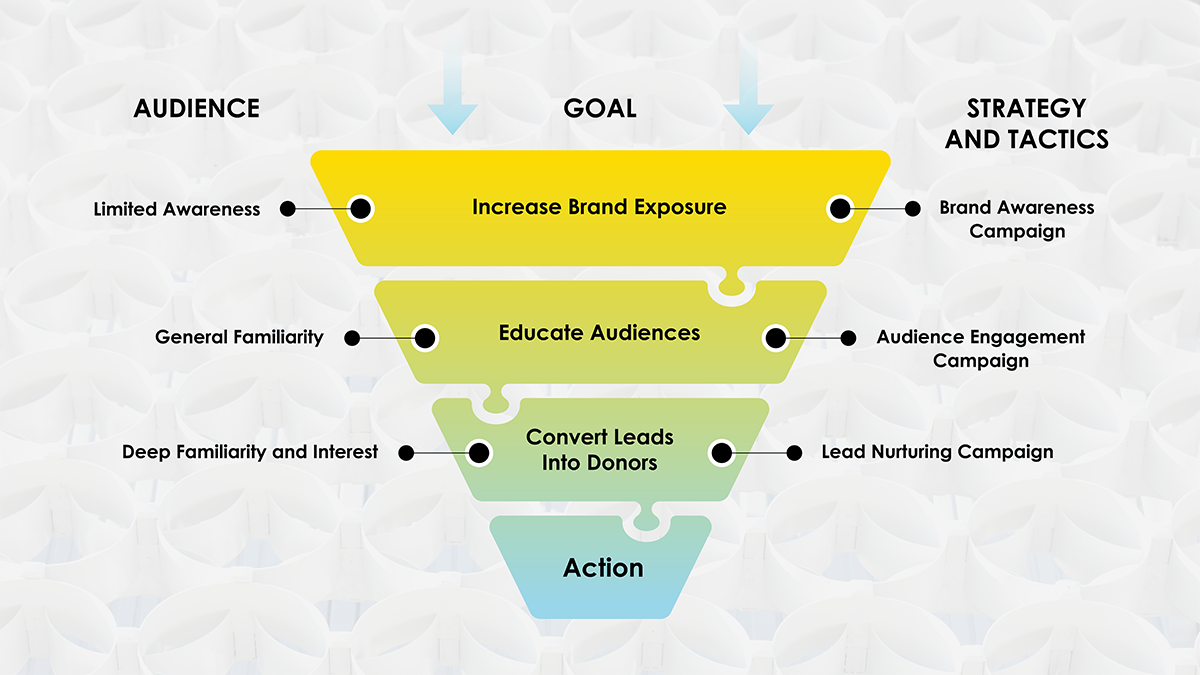
The following is an example funnel for the goal of increasing corporate sponsorships.
Increasing Corporate Sponsorships
| The Phase | The Audience | The Goal | The Strategy and Tactics |
| Top-Funnel | The audience has little to no awareness of what the organization is or what it does. | To increase brand exposure and understanding of the organization’s purpose. | Create a brand awareness campaign that can include digital and social media ads, billboard ads, video and radio ads, etc. |
| Middle-Funnel | The audience is familiar with the organization, but is not fully aware of what it does or can do. | To improve audience education, push value messaging, and strengthen trust. | Create an engagement campaign that can include email marketing, social media marketing, print advertising, etc. |
| Bottom-Funnel | The audience knows the organization fairly well and has shown interest in getting involved. | To convert the audience from lead to donor, encouraging them to take action. | Create a lead-nurturing campaign that can include retargeting, direct mail marketing, email marketing, etc. |
No matter how many goals are in your marketing plan, it’s helpful to craft a funnel breakdown to see where your audience is and what your marketing needs to accomplish to get that audience to donate or otherwise support your organization.
7 Steps to Creating an Effective Nonprofit Marketing Strategy
Are you ready to see your nonprofit organization soar with effective marketing? Great! We’re ready to help by providing seven steps to creating an effective nonprofit marketing strategy.
1. Evaluate Past or Current Marketing Efforts
Unless you’re a brand-new organization, your nonprofit has tried marketing before. Think back or look at previous data to see what worked, what failed, and what could have been improved to reach even more people and convert more prospective supporters into actual donors, advocates, and volunteers.
When evaluating past or current marketing efforts, ask yourself:
- What were the specific goals we were striving for?
- What were the goals we reached?
- What marketing channels did we use?
- What channels could we have used?
- What did we miss in our marketing efforts?
- What underperformed?
- Where could improvements have been made?
The more you understand about your past and current strategies, the better equipped you’ll be to improve with your next strategy.
2. Create SMART Marketing Goals

A strategy is nearly impossible to shape if there is no goal it’s striving to reach. And without any marketing goals, it’s completely impossible to know if your marketing efforts are working.
Define the goals you want your nonprofit marketing to achieve. Doing so plots out the best path forward and determines the actions or tactics needed to proceed as effectively as possible.
But they cannot be just any type of goals. They need to be SMART.
SMART Goals
A SMART goal is specific, measurable, achievable, relevant, and time-bound. For example, let’s say you need to construct a facility within the next 5 years to continue carrying out your organization’s cause. And let’s say the estimated cost of that project is going to be $500,000, your SMART goal could be:
“To collect $500,000 from sponsorships, corporate donors, and individual donations in the next five years to cover construction costs.”
This goal is:
- Specific: There is a set amount—$500,000—your organization is striving to collect.
- Measurable: Throughout the five-year period, you can track progress and determine whether you are on track to collect that amount by your deadline. Based on the progress at each check-in, you can adjust, pivot, or push forward to reach or even exceed your goal.
- Achievable: While a start-up or a smaller nonprofit may not have the tools and resources to raise $500,000 in five years, an organization with a fairly large donor base, community support and awareness, compelling messaging, and a strong cause is more able to achieve it with the right strategies.
- Relevant: If a $500,000 construction project will improve the way you carry out your mission and impact your beneficiaries, then the goal is relevant. If it ultimately will have no impact on your operations, then it is not a relevant goal to strive for.
- Time-bound: With a deadline of 5 years, you have given your organization and your donors a clear timeframe.
3. Define Your Audience
Depending on how long your organization has been around, you are likely to know your audience well. But whether you’ve been around for a while or you’re a newer organization, it’s always a good idea to perform an audit of your audience, clarify your definition of who they are, and improve your understanding of how they operate.
As a nonprofit, you need to target several types of audiences, which could include:
- Prospective donors
- Active and existing donors
- Volunteers
- Partners
- Advocates
- Beneficiaries
- General community members
When looking at each group of your audience, it’s helpful to define clearly:
- Who each audience is (Demographics like age, sex, education, income, geographic location, family status, etc.)
- How each audience thinks (Psychographics like personality, lifestyle, values, attitudes, interests, etc.)
- Their “why” (Why do they donate to you? Why do they partner with or support you? Why do they use your services? Etc.).
- Their “when” (When are they most likely to donate? When are they most likely to become a partner? When are they most likely to use your services? Etc.)
To help you define these aspects of your audience, it’s wise to build audience personas, or detailed representations of your ideal donors, partners, supporters, and beneficiaries. Through market research and data analysis of your current bases, you can craft complete personas that can be used as a guiding light when creating goal-focused marketing strategies, targeted campaigns, and personalized messages for each audience.
4. Define Your Messages Based on Your Audiences
Each audience is different and requires a personalized message that will a) resonate effectively, and b) speak to the goal you are aiming to achieve. The message you send out to your donors can’t be the same as the message you send out to your beneficiaries. It’s not even the same as the message you send out to your partners or community advocates. However, the messages for all three should be cohesive in that they all point back to the goals defined in step 2.
It’s vital to establish a goal-driven core message for each of your audiences and then craft your audience-specific campaigns around those core messages.
5. Choose Your Marketing Channels Based on Your Audiences
Audience-based marketing channels may be more challenging to navigate than audience-based messages. For instance, your donor audience may comprise older donors who like more tangible marketing materials like pamphlets and brochures, as well as younger donors who prefer emails and online videos.
Think through the demographics of each audience and the efficacy of each possible marketing channel to determine the ones that will a) most likely reach the people within the audience and b) reach them in impactful ways.
6. Execute Your Marketing Tactics
Now that you’ve laid the groundwork, defining your goals, your audience, and your marketing channels to use, it’s time to execute your campaigns.
There are plenty of tactics you can incorporate into your marketing campaign, all of which are designed to increase awareness of your organization and help grow your support base.
Depending on what you determined in your discussions about your audience and your marketing channels, campaign execution could include:
Website Design or Redesign
If you don’t have a website, it’s vital to craft one. If you have a website that hasn’t been updated within the last five to ten years, it’s just as crucial to update it with better UX design, content improvements, and more.
Your website is your greatest piece of online real estate, your digital home base, and is often responsible for the most impactful impression you will make on your audiences.
Depending on the quality of your website, it is either promoting or hindering your engagement efforts.
In fact, think of your site like an additional team member that is always at work:
- Is your website attractive, user-friendly, up to date, and well-maintained? Then you have a huge asset on your team!
- Is your website outdated, missing content or compelling imagery, overall lackluster, or challenging to navigate? Then you have a pretty bad team member in a critical seat.
- Do you not have a website at all? Then you’re short one critical team member that audiences expect you to have.
Simply put, if you want to grow, your organization needs a website that is attractive, user-friendly, compelling, and built to push engagement, donations, and other forms of support.
Pay-Per-Click (PPC) Advertising
PPC advertising, like Google Ads or Bing Ads, is online advertising that places your brand directly in front of users searching for organizations like yours. PPC ads can appear as:
- Search ads: sponsored ads that appear at the top of page 1 on Google in relevant searches.
- Display ads: Banner ads that appear on webpages that are a part of either the Google Display Network (GDN) or the Microsoft Display Network (MDN).
- Video ads: Display ads that appear before, during, or after videos on platforms like YouTube.
For more on PPC ads, check out our Definitive Guide to Search Engine Marketing.
Social Media Advertising
Similar to PPC ads, social media advertising involves sponsored ads appearing in feeds on platforms like Facebook, Instagram, and LinkedIn.
Social media ads can include:
- Graphic posts
- Carousels
- Videos
- Story ads
For more on social media ads, check out our Definitive Guide to Social Media Marketing.
Geofencing Ads
Geofencing advertising is a location-based marketing tactic that targets users who cross a virtual boundary (the geofence) with a mobile device like a smartphone or tablet. Once the fence is crossed, targeted ads designed for that location’s occupants or visitors boost brand exposure and messages.
For more on Geofencing, check out our Definitive Guide to Geofencing and Location-Based Marketing.
Email Marketing
Email marketing is an effective tool for communicating directly with your various audiences. Donors, volunteers, or those interested in getting involved can sign up for your newsletter to receive regular, quick-read emails that provide content relevant to them.
Use email marketing to:
- Educate audiences on what your organization does for the community it serves
- Show donors where their dollars have gone and will be going
- Promote upcoming fundraising events or community outreach events
- Update subscribers on fundraising progress
For more on email marketing, check out our Definitive Guide to Email Marketing.
Video Advertising
Videos are highly effective marketing tactics that can significantly enhance your organization’s marketing strategy.
Video works to convey a message or series of messages in a way that images or the written word simply cannot. Videos help create strong emotions with precision and clarity. They can push several messages all at once without forcing the viewer to think too hard about what they are seeing. They allow you to show, not tell, in more dynamic ways than photography alone.
Video is a powerful tool, especially for nonprofits working on impactful causes.
For more on video marketing, check out our Definitive Guide to Video Marketing.
Direct Mail Ads
Online channels aren’t the only ones effective at impacting your audience. Direct mail campaigns can put your brand and message directly in people’s hands. Send postcards, flyers, and other printed pieces to target audiences, like prospective donors or partners. Be sure to include compelling calls to action that encourage recipients to make a donation, volunteer, or visit your website to learn more.
For more on direct mail ads, check out our Definitive Guide to Traditional Advertising.
Billboard Advertising
Billboard ads and other out-of-home (OOH) advertising are effective at placing your brand in front of broader audiences, increasing brand exposure and brand recall. These ads should not be used to share a lengthy or detailed message like you would with email marketing or direct mail advertising. Instead, billboard ads should feature your branding, including your logo, along with a brief message and/or a clear call to action, like a phone number or website URL.
For more on billboard ads, check out our Definitive Guide to Traditional Advertising.
7. Track Campaign Performance
The time, energy, and money your nonprofit spends on marketing cannot be wasted. That’s why routine evaluation and performance tracking are vital. Analyzing your campaign shows you how well you’re moving toward your SMART goals. It ensures your budget is not being wasted. It shows you where to pivot when necessary to enhance or strengthen your efforts for more positive outcomes.
You can analyze your campaign’s performance by tracking:
- Web traffic
- Traffic sources
- Click-through rates
- Conversion rates
- Engagement rates
- Email open rates
- Call tracking data
- URL tracking data
And plenty of other vital data collected from your marketing campaign.
Why Partner With an Agency That Knows Nonprofit Marketing?
Nonprofit marketing is as simple as it is complex. You have a guiding vision that you’re working toward and a mission or missions that build toward that vision. Your marketing needs to communicate this and additional messages to numerous audiences as impactfully as possible while keeping budget and time constraints in mind.
It’s a complicated, challenging juggling act for any in-house marketer or marketing team. But when you partner with a full-service marketing agency, like M&R Marketing, that has years of experience marketing for nonprofit organizations throughout Georgia, the juggling gets significantly simpler.
The experts at M&R will walk alongside you, starting with our very first discovery meeting, providing the services, expertise, tools, and everything else needed to craft and execute a unique and stellar marketing plan for your organization. There are no cookie-cutter solutions here at M&R. Instead, we dive deep into your organization to understand how it operates, what its unique marketing needs are, and what solutions we can craft that will reach audiences and drive growth.
Since 2008, M&R Marketing has worked with nonprofit organizations throughout Georgia, crafting marketing strategies and executing tactics that have reached organizations’ goals campaign after campaign.
Want proof? Check out the full case studies of some of our nonprofit clients:

Other Nonprofits We Have Served
- Anchor of Hope Foundation
- Boys & Girls Club of Central Georgia
- Campus Clubs
- Caring Solutions
- Central Georgia CASA
- Georgia Family Connection Partnership
- Georgia FLEX
- Georgia Rural Health Innovation Center
- Health Equity Navigator Program
- Healthy Connect
- Jay’s HOPE
- Loaves and Fishes
- Next Level Community Development
- Peyton Anderson Foundation
- Pheobe Foundation
- Rescue Mission of Middle Georgia
- South Georgia Healthy Start
- The Methodist Home
- Weekend Lunch
Types of Nonprofit Organizations We Serve
- Charitable
- Religious
- Educational
- Medical
- Social and Recreational
- Community
Our Proven Process
Regardless of your type of organization, M&R follows a proven process for crafting your effective, individualized nonprofit marketing strategy:
Discover: Before we begin any project, we start by thoroughly exploring your practice or organization. We discover your story, values, target market, and goals. Without this vital information, we cannot move forward in good faith.
Strategize: Based on our discovery, we will develop a highly customized strategic marketing solution designed to target your specific needs.
Communicate: We clearly communicate your vision and project goals to the team members assigned to your project(s).
Create: While every step in our proven process requires creativity, this is the point where our creative juices really start flowing as we create and launch your strategic solutions to market.
Evaluate: Launch does not equal complete. We must evaluate performance data after the go-live date to see what’s working, what areas could use improvement, and how to adjust to optimize your marketing efforts.
Create an Effective Nonprofit Marketing Strategy With M&R Marketing
If it’s time for your organization to receive the attention it deserves, it’s time to partner with M&R Marketing. As an in-house team of digital marketers, web developers, graphic designers, copywriters, project managers, and business development managers, our agency is ready to design and execute the custom marketing solutions you need to compel your audience, earn trust, increase your donor base, and optimize how your organization supports its cause and mission.
Ready to Get Started? Call M&R Marketing at 478-621-4491 and Tell Us About Your Nonprofit Marketing Needs Today.
More Definitive Guides From M&R Marketing: